Cognitive Behavioural Therapy (CBT)
CBT is an evidenced based therapy commonly offered within the NHS which has been shown to be effective in treating depression and a wide range of anxiety related disorders.
It is based on the idea that thoughts, feelings and behaviour are all connected and that unhelpful ways of thinking and coping contribute towards vicious cycles, which maintain feelings of distress.
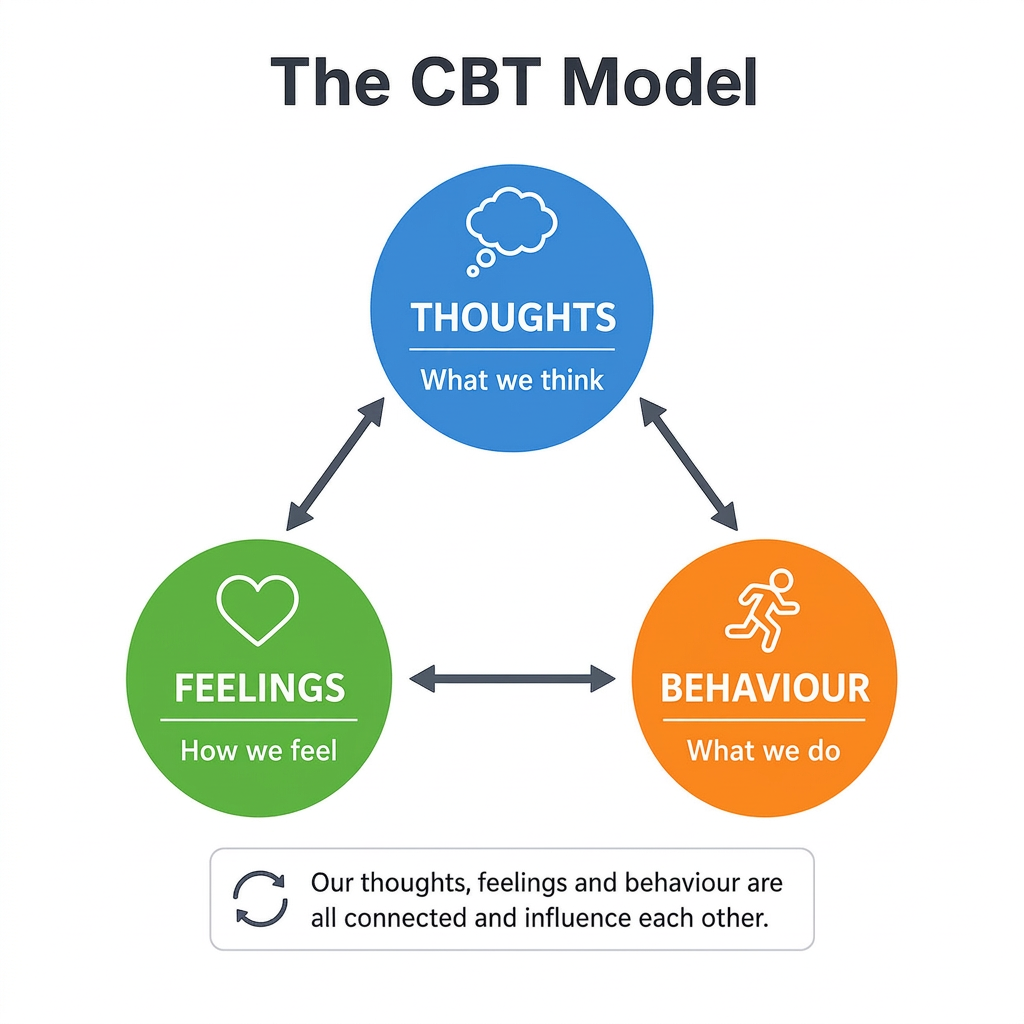
Core principles of CBT
Thoughts can be misleading: Sometimes our thoughts can be inaccurate or unhelpful. Since thoughts and emotions are linked, changing the way you think, or respond to thoughts, can reduce the emotional distress that you experience.
Behaviours can keep problems going: Thoughts can cause you to act in certain ways that strengthen negative beliefs and make the problem worse. For example; if you experience low self-esteem, you might avoid opportunities available to you, which reinforces a sense of not being good enough.
What does CBT involve
Assessment: Your therapist will ask you about your difficulties and when they started.
Goal setting: Helping you to focus on what is important to you.
Formulation: Understanding the problem and what is keeping it going.
Examining thoughts: Noticing and questioning the accuracy/helpfulness of your thoughts.
Changing behaviour: Experimenting with doing things differently allows you to test out whether your thoughts are accurate.
Developing new skills: Your therapist will teach you new skills for how to cope with challenging situations.
Practice assignments: You and your therapist will agree on practice assignments each week to build on your progress outside of the sessions.
Frequently asked questions
How long will the sessions be?
CBT sessions are usually 50-60 minutes long.
Will I need to complete homework?
You and your therapist will agree on practice assignments each week to build on what you have covered in the session. For example, a practice assignment might involve keeping a thought record, experimenting with doing something differently or practicing a new skill.
Is CBT effective?
The National Institute for Health and Care Excellence (NICE) recommends CBT as a first choice for a range of problems.
Phobias and OCD – CBT is the most effective psychological treatment for phobias and OCD.
Anxiety and depression – CBT is one of the most effective treatments for conditions where the main problem is anxiety (eg. generalised anxiety disorder or panic disorder) or depression.
Contact Us for more information.
 farrowtherapy.co.uk