EMDR Therapy
Eye Movement Desensitisation and Reprocessing (EMDR) Therapy is an evidenced based treatment most commonly known for treating psychological difficulties arising from traumatic experiences.
EMDR works by activating the brains natural healing mechanisms, helping you to process memories that are ‘stuck’ in the memory network. This removes their emotional charge and helps change how you think, feel and behave when confronted with a trigger that reminds you of the event.
Core principles
Treating the root causes: ‘Unprocessed’ memories are thought to be central to a persons difficulties.
Bilateral stimulation (BLS): Alternating BLS such as eye movements, tapping or auditory tones to help to activate the brains natural healing mechanism so that you are able to process traumatic memories safely.
Past, present and future: EMDR can target past traumatic experiences, current triggers and imagined future situations that can cause distress. It helps the past feel like the past rather than something that’s happening now.
The EMDR model
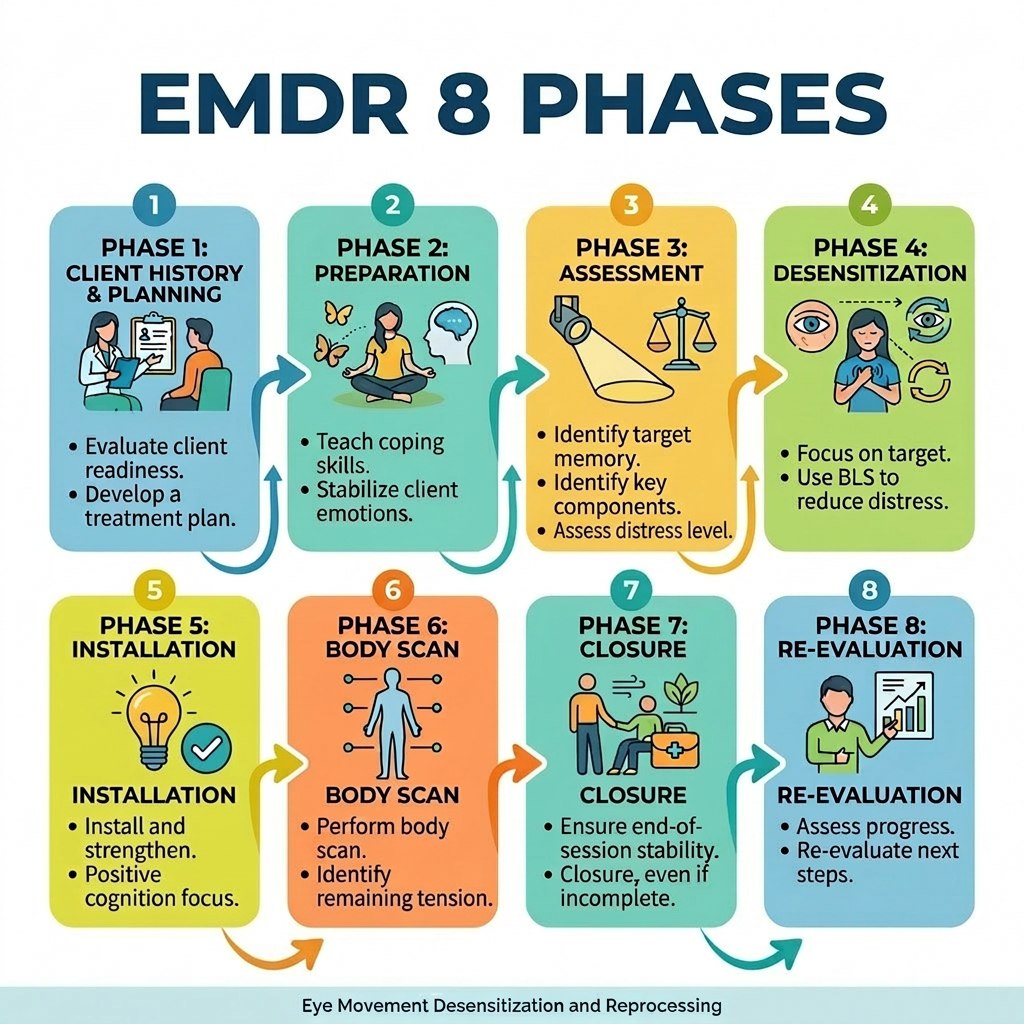
Your therapist will guide you through a structured 8-phase model.
To start with, your therapist will obtain an overview of your difficulties, including a history of your past experiences and how they affect you now.
Your therapist will then teach you to stay grounded and manage distress. This is an important step, particularly for individuals who may have experienced lots of trauma in their lifetime, with the time spent in this stage varying from person to person.
When ready, you will be encouraged to recall memories alongside a form of BLS, where you will focus on a distressing memory along with any associated negative beliefs, emotions and bodily sensations. A significant benefit of EMDR is that it does not require you to describe traumatic experiences in great detail, as the process will activate your brains natural healing mechanisms. You simply ‘notice’ what comes up.
You will repeat this step until the memory causes less distress. For some people this will happen very quickly whilst for others this may take several sessions. This is often dependent on individual processing styles and goals, and the complexity of the problem.
Watch this short video explaining EMDR (opens in new window) https://www.youtube.com/watch?v=bIJZQAr9nQo
Frequently asked questions
How long will the sessions be?
EMDR sessions usually last 60-90 minutes. Longer sessions may be required during phases 3-7 to allow adequate time for processing and to safely close down the session. Your therapist will discuss this with you if they think longer sessions are needed.
How many sessions will I need?
The average number of sessions is between 6-12. Generally speaking, the more isolated the traumatic memory being treated, the shorter the treatment tends to be.
People with multiple traumas and/or complex histories of childhood abuse or neglect may require more extensive therapy, including substantial preparatory work in phase 2 of EMDR. Your therapist will discuss this with you if they think this is necessary.
How much do sessions cost?
Please see the fee’s page for further information.
How effective is EMDR?
EMDR is endorsed by the UK’s National Institute for Health and Care Excellence (NICE) and World Health Organisation, and is available through the NHS for the treatment of Post-Traumatic Stress Disorder (PTSD) and Complex Post-Traumatic Stress Disorder (C-PTSD).
There has been a large amount of research reviewing the efficacy of EMDR and EMDR has been clinically validated by a number of randomised, controlled studies from all over the world.
A full list of research into the clinical effectiveness of EMDR can be found here (opens in new window) https://francineshapirolibrary.omeka.net/
What else can EMDR help with?
In addition to research evaluating the effectiveness of EMDR in overcoming PTSD and trauma, there is a growing body of research indicating that EMDR can be helpful for a range of other issues such as phobia’s, panic attacks and depression.
 farrowtherapy.co.uk